

INFORMATION
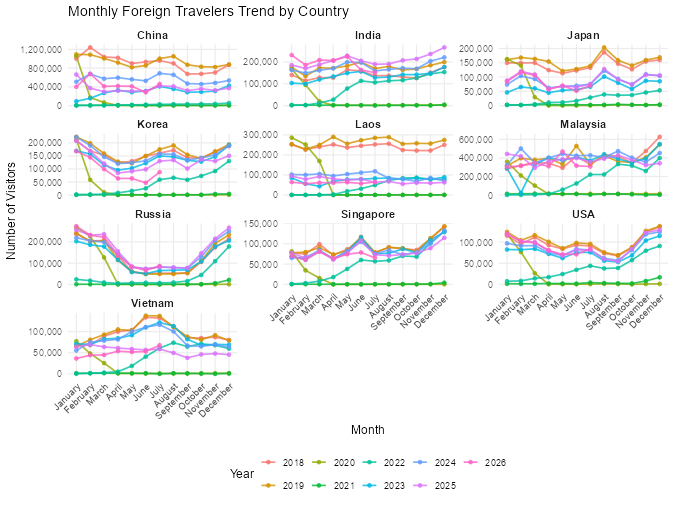
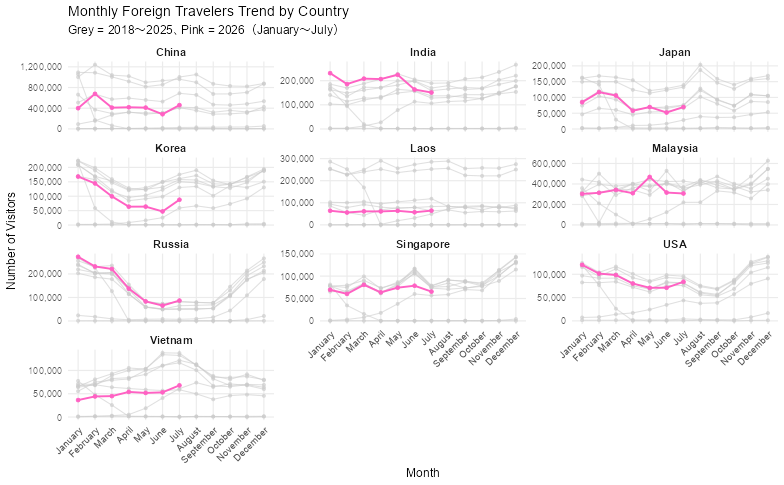
Prepared by HS-TECH with ggplot2 in positron.
Here is a summary of the characteristics of travelers from the top 10 countries, with detailed insights for Japan, China, the US, and Russia, and concise overviews for the rest based on the data trends from 2018 to 2026.
Japan
Travelers from Japan have shown a steady pattern with notable seasonality, typically peaking slightly in August and December. Pre-2020, annual visitor numbers were around 1.7 to 1.8 million. While the numbers fell sharply during 2020–2021, a gradual recovery began in late 2022. By 2025, annual travelers surpassed 1 million again, though this is still roughly 60% of pre-pandemic levels. The recovery has been relatively cautious compared to other nations, with stable numbers returning but not yet reaching previous highs.
China
China is a massive volume driver, consistently contributing the highest number of travelers. Before 2020, annual arrivals exceeded 11 million. The data reflects a rapid post-2022 rebound, with over 3.5 million arrivals in 2023 and a massive surge to 6.7 million in 2024. Interestingly, this momentum slowed to around 4.4 million in 2025. Chinese travel patterns show strong peaks during early-year holidays (like January) and mid-summer (July/August), demonstrating high sensitivity to major holiday periods.
United States
The US represents a highly stable, long-haul travel market. Before 2020, annual arrivals were consistently around 1.1 to 1.2 million. The recovery here has been robust and rapid; by 2024, the numbers had already bounced back to over 1 million, and by 2025, they were near the 1.1 million mark again. The US shows distinct travel peaks during the winter holidays (December/January), indicating a preference for escaping colder weather or utilizing holiday time for long-distance travel.
Russia
Russia exhibits the most extreme seasonal travel patterns among the top 10 countries. Arrivals skyrocket during the winter months (December through February), with single-month arrivals frequently exceeding 200,000, while summer numbers (June/July) drop drastically to under 80,000. Remarkably, the Russian market recovered rapidly; total arrivals in 2024 (1.74 million) and 2025 (1.89 million) have actually exceeded pre-2020 levels, indicating a very strong and growing preference for winter travel to this destination.
Brief Summaries for Other Nations:
-
Malaysia: The highest volume driver from neighboring countries, quickly rebounding to pre-pandemic levels (close to 4.9 million in 2024) with relatively stable month-to-month traffic.
-
India: Showing aggressive growth, exceeding pre-2020 numbers by 2024 and reaching nearly 2.4 million in 2025, driven by steady year-round arrivals.
-
South Korea: A major contributor (around 2 million pre-2020) that showed a strong initial rebound in 2023–2024, though numbers slightly softened in 2025.
-
Laos: Represents consistent cross-border traffic, with a solid recovery peaking at 1.1 million in 2024, maintaining steady volumes without extreme seasonal spikes.
-
Singapore: A very stable market that has largely recovered to its pre-2020 baseline of around 1 million annual travelers, maintaining consistent flow throughout the year.
-
Vietnam: Demonstrated a strong early recovery in 2023 (over 1 million) but has seen numbers drop significantly in 2025, showing higher volatility compared to other regional neighbors.