

| Cat. No. | Category | Item No. | Business / Activity |
|---|---|---|---|
| 1 | Livestock and pet-related businesses | 1 | Breeding, raising, and nursing of animals of any kind |
| 2 | Operating a business of keeping or collecting animals, or a similar business, for public viewing or for the benefit of the business, whether or not an admission or service fee is charged directly or indirectly | ||
| 2 | Animals and animal products | 1 | Slaughtering or butchering animals, except at food-vending premises, mobile vending, or market sales |
| 2 | Curing, tanning, drying, or stockpiling animal hides or fur | ||
| 3 | Stockpiling unprocessed horns, bones, or animal parts | ||
| 4 | Rendering/boiling hide, sinew, or animal fat | ||
| 5 | Manufacturing goods, utensils, or other products (not for food purposes) from shells, carapaces, bones, horns, hides, fur, or other animal parts by boiling, steaming, drying, burning, or any other process | ||
| 6 | Manufacturing, milling, grinding, crushing, mixing, packing, stockpiling, or otherwise processing animals, plants, or any part thereof, for animal feed or animal-feed ingredients | ||
| 7 | Producing, processing, stockpiling, or washing lac (shellac resin) | ||
| 3 | Food, beverages, and drinking water (excl. food-vending premises, hawking, market sales, and household consumption production) | 1 | Producing, stockpiling, or repacking curry paste, ready-made chili paste, fermented soybean paste, soy sauce, dipping sauces, or various seasoning sauces |
| 2 | Producing, stockpiling, or repacking fermented/pickled animal-based foods, e.g. pla-ra, pickled fish, pickled shrimp, sour fish, fermented pork (naem, mum), sausages, shrimp paste, fish sauce, pickled shellfish, or similar products | ||
| 3 | Producing, stockpiling, or repacking fermented, pickled, or candied food from vegetables, fruit, or other plants | ||
| 4 | Producing, stockpiling, or repacking food from plants or animals by drying, grinding, steaming, boiling, stewing, simmering, stirring, coating, frying, baking, smoking, grilling, roasting, or any other method | ||
| 5 | Producing, stockpiling, or repacking meatballs | ||
| 6 | Producing, stockpiling, or repacking rice vermicelli, khanom chin, noodles, soybean pudding, tofu, glass noodles, kiam-i, meat substitutes, or similar products | ||
| 7 | Producing egg noodles, macaroni, spaghetti, pasta, or similar products | ||
| 8 | Producing fresh bread, dried bread, jan-ap, moon cakes, or other baked goods | ||
| 9 | Producing, stockpiling, or repacking milk or dairy products | ||
| 10 | Producing, stockpiling, or repacking butter, margarine, blended butter, or related butter/margarine products | ||
| 11 | Producing ice cream | ||
| 12 | Roasting, stockpiling, or repacking coffee | ||
| 13 | Producing, stockpiling, or repacking dried tea leaves, powdered tea, or other powdered beverages | ||
| 14 | Producing, stockpiling, or repacking ethyl alcohol, liquor, beer, wine, vinegar, khao-mak, or fermented sugar/palm wine | ||
| 15 | Producing distilled water, potable water, or drinking water from vending machines | ||
| 16 | Producing, stockpiling, repacking, or transporting ice | ||
| 17 | Producing, stockpiling, or repacking carbonated drinks, sweetened drinks, soda water, plant/vegetable/fruit drinks, or beverages packed in cans, bottles, or other containers | ||
| 18 | Producing, stockpiling, or repacking canned, bottled, or other-container-packed food | ||
| 19 | Producing, stockpiling, or repacking MSG or food additives/seasoning agents | ||
| 20 | Producing, stockpiling, or repacking sugar or syrup | ||
| 21 | Producing, stockpiling, or repacking bae-sae (maltose syrup) | ||
| 22 | Shelling, trimming, or washing aquatic animals, where not part of a cold-storage business | ||
| 23 | Operating a cold-storage / food-freezing facility | ||
| 24 | Storing or preserving food using machinery | ||
| 4 | Medicine, medical supplies, medical equipment, cosmetics, and cleaning products | 1 | Producing, milling, grinding, mixing, or packing medicine/drugs |
| 2 | Producing/packing toothpaste, shampoo, wet wipes, or cosmetics, including body soap | ||
| 3 | Producing/packing cotton wool or cotton-wool products | ||
| 4 | Producing bandages, wound dressings, sanitary napkins, or disposable diapers | ||
| 5 | Producing detergent, soap, cleaning solutions, or other cleaning products | ||
| 5 | Agriculture-related businesses | 1 | Producing, stockpiling, or repacking vegetable oil |
| 2 | Washing, drying, smoking, or stockpiling raw (unprocessed) rubber | ||
| 3 | Producing or repacking tapioca starch, sago starch, other plant-derived starch, or similar flour | ||
| 4 | Milling rice, threshing rice by machine, or repacking rice by any method | ||
| 5 | Producing tobacco | ||
| 6 | Polishing, hulling, or grinding grain/seeds | ||
| 7 | Producing, stockpiling, or repacking fertilizer or fertilizer-production materials | ||
| 8 | Producing plant fiber | ||
| 9 | Drying, stockpiling, or transferring cassava, paddy rice, sugarcane, or corn produce | ||
| 6 | Metal or mineral businesses | 1 | Producing containers, jewelry, tools, equipment, or other utensils from metal or minerals |
| 2 | Smelting ore, or melting/casting metal of any kind, except businesses licensed under 6(1) | ||
| 3 | Turning/lathing, drilling, welding, forging, cutting, brazing, rolling, or pressing metal by machine, gas, or electricity, except businesses licensed under 6(1) | ||
| 4 | Coating or plating metal with lead, zinc, tin, chromium, nickel, or other metal, except businesses licensed under 6(1) | ||
| 5 | Polishing or washing metal by machine or with chemicals, except businesses licensed under 6(1) | ||
| 6 | Mining, stockpiling, separating, sorting, or washing ore/minerals | ||
| 7 | Motor vehicles, machinery, or mechanical equipment | 1 | Building, assembling, panel-beating, body-repairing, spray-painting, or applying anti-rust coating to motor vehicles |
| 2 | Manufacturing motor vehicles, machinery, or mechanical equipment | ||
| 3 | Repairing or tuning engines, machinery, mechanical equipment, electrical systems, air-conditioning systems, or component parts thereof | ||
| 4 | Operating a motor-vehicle/machinery/mechanical-equipment sales-and-service business that also repairs or refurbishes such vehicles/equipment | ||
| 5 | Washing, polishing, coating, or lubricating (greasing) motor vehicles | ||
| 6 | Producing, stockpiling, selling, repairing, or charging batteries | ||
| 7 | Selling, repairing, patching, or vulcanizing vehicle tires, or wheel alignment/balancing | ||
| 8 | Producing, repairing, assembling, or pressing brake pads or clutch linings | ||
| 9 | Stockpiling or repairing old mechanical equipment, old machinery, or component parts of old motor vehicles/machinery/mechanical equipment | ||
| 8 | Wood or paper businesses | 1 | Producing matches |
| 2 | Sawing, slicing, sanding, planing, drilling, grooving, molding, or cutting wood by machine | ||
| 3 | Producing, spraying, or applying varnish/paint to finish goods, utensils, or products made of wood, rattan, or bagasse | ||
| 4 | Kiln-drying wood | ||
| 5 | Producing, stockpiling, or repacking incense sticks | ||
| 6 | Producing goods, utensils, stationery, or other products made of paper | ||
| 7 | Producing various types of paper | ||
| 8 | Charcoal burning or stockpiling charcoal | ||
| 9 | Service businesses | 1 | Operating a spa business, except services provided in a medical facility under the law on medical facilities, or in a licensed health-service establishment under the law on health-service establishments |
| 2 | Operating an "aap-op-nuat" (bath-sauna-massage) business | ||
| 3 | Operating a health-massage business, except services provided in a medical facility, or in a licensed health-service establishment | ||
| 4 | Operating a bathing facility, steam sauna, or herbal sauna, except services provided in a medical facility, or in a licensed health-service establishment | ||
| 5 | Operating a hotel, or non-hotel accommodation provided for the temporary lodging of travelers or others for a fee, or similar businesses | ||
| 6 | Operating a dormitory, rental condominium, rented rooms, or subdivided rented rooms, or similar businesses | ||
| 7 | Operating a theater / entertainment venue | ||
| 8 | Providing entertainment shows, music performances, dancing, ramwong, rongeng, discotheque, karaoke, jukebox, or similar entertainment | ||
| 9 | Operating a swimming pool, or similar business, except services licensed under 9(1) | ||
| 10 | Operating a skating or rollerblading facility, or similar activities | ||
| 11 | Operating a beauty salon or hairdressing business, except businesses subject to the law on the practice of the medical profession, or the law on health-service establishments | ||
| 12 | Operating a fitness / exercise facility | ||
| 13 | Operating a weight-control service business | ||
| 14 | Operating an amusement park, bowling alley, or game arcade | ||
| 15 | Operating a computer / internet service business | ||
| 16 | Operating a golf course or golf driving range | ||
| 17 | Operating a medical, public-health, scientific, or environmental laboratory | ||
| 18 | Operating a tattooing or body-piercing business | ||
| 19 | Providing childcare services at the client's home | ||
| 20 | Providing elderly-care services at the client's home | ||
| 21 | Providing pet spa, bathing, grooming, or temporary pet-boarding services | ||
| 22 | Operating a container storage yard, or a container-truck-head parking yard | ||
| 10 | Textile businesses | 1 | Spinning yarn, winding thread, weaving cloth by machine, or weaving with a fly-shuttle loom |
| 2 | Stockpiling jute, hemp, cotton, kapok, or synthetic fiber | ||
| 3 | Spinning cotton, kapok, or synthetic fiber by machine | ||
| 4 | Weaving mats, sacks, carpets, or other textiles by machine | ||
| 5 | Sewing or embroidering cloth or other textiles by machine | ||
| 6 | Printing on cloth or other textiles | ||
| 7 | Washing, drying, ironing, or pleating cloth by machine | ||
| 8 | Dyeing, bleaching, or discharge-printing cloth or other textiles | ||
| 11 | Stone, soil, sand, cement, or similar materials | 1 | Producing earthenware vessels or terracotta products |
| 2 | Blasting, milling, crushing, or pulverizing stone by machine | ||
| 3 | Producing goods, utensils, or other products from cement or similar materials | ||
| 4 | Stockpiling or mixing cement, stone, soil, sand, or construction materials, including excavating, scooping, dredging, milling, crushing, or pulverizing by machine, except businesses licensed under 11(2) | ||
| 5 | Cutting/faceting diamonds, gemstones, stone, glass, or similar materials | ||
| 6 | Sawing, cutting, or crafting stone into goods, utensils, or various products | ||
| 7 | Producing chalk, plaster, lime, dinsopong (white clay), or lime (limestone) burning | ||
| 8 | Producing products containing asbestos as a component or ingredient | ||
| 9 | Producing, cutting, or grinding glass or glass products | ||
| 10 | Producing sandpaper or emery cloth | ||
| 11 | Producing fiberglass or fiberglass products | ||
| 12 | Washing or sandblasting the surface of glass, stone, or other materials, except businesses licensed under 6(5) | ||
| 12 | Petroleum, petrochemicals, coal, coke, and various chemicals | 1 | Producing, stockpiling, packing, or transporting acids, alkalis, oxidizing agents, or solvents |
| 2 | Producing, stockpiling, packing, or transporting gas | ||
| 3 | Producing, stockpiling, refining, or transporting petroleum or petroleum products | ||
| 4 | Producing, stockpiling, or transporting coal or coke | ||
| 5 | Spray-painting, except businesses licensed under 7(1) | ||
| 6 | Producing goods, utensils, or products from synthetic rubber, plastic, celluloid, bakelite, or similar materials | ||
| 7 | Milling, stockpiling, or grinding resin/pitch (chan) | ||
| 8 | Producing paint or paint-mixing oil | ||
| 9 | Producing or developing/washing photographic film or motion-picture film | ||
| 10 | Coating or dipping objects with plastic, celluloid, bakelite, or similar materials | ||
| 11 | Producing plastic, celluloid, bakelite, or similar materials | ||
| 12 | Producing or packing fire-extinguishing chemicals | ||
| 13 | Producing dry ice | ||
| 14 | Producing, stockpiling, or transporting fireworks, or chemicals that are components in fireworks production | ||
| 15 | Producing shellac or varnish | ||
| 16 | Producing, stockpiling, packing, or transporting pesticides or disease-vector control agents | ||
| 17 | Producing, stockpiling, or packing glue/adhesive | ||
| 13 | Other businesses | 1 | Printing books or similar publications by machine |
| 2 | Manufacturing or repairing electronic devices, electrical appliances, electronic components, or electrical equipment | ||
| 3 | Producing candles or similar materials | ||
| 4 | Blueprint printing or photocopying | ||
| 5 | Stockpiling damaged, used, or surplus materials/goods | ||
| 6 | Operating a warehouse | ||
| 7 | Washing used bottles, containers, or packaging for reuse or reprocessing into new products | ||
| 8 | Printing, writing, spray-painting, or applying other methods to non-textile objects | ||
| 9 | Operating a fishing-boat pier, fish-market pier, or fish raft/platform | ||
| 10 | Packing goods by machine | ||
| 11 | Providing pest-control services for insects or disease-vector animals | ||
| 12 | Producing goods, utensils, or products from rubber | ||
| 13 | Producing, stockpiling, or transporting biodiesel and ethanol | ||
| 14 | Operating an edible bird's-nest (swiftlet) business, and cleaning or trimming swiftlet nests |
INFORMATION
2026-09-30 10:32:00
- Does the SDS for your product accurately reflect its GHS hazard classification?
- Is the information consistent across all 16 sections?
HS-TECH not only prepares new SDSs but also provides independent, third-party reviews of your existing ones.
Contact us: https://hstecheng.com/contact
------
Related information;
A shocking and intolerable level of SDS quality
https://hstecheng.com/free/sds-quality
Thai SDS Template is now available
https://hstecheng.com/free/thaisds_template
Thai SDS Authoring Services
https://hstecheng.com/free/thaisds
HS-TECH
https://cdn.goope.jp/21561/260110140348-6961ddb40a213.pdf
2026-09-25 11:48:00
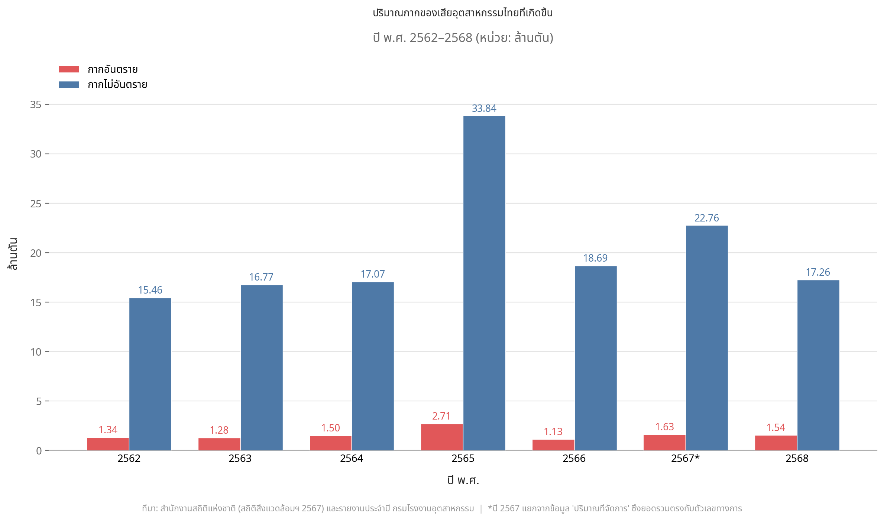
จุดเปลี่ยนที่เห็นได้ชัดคือ ปี 2565 เมื่อปริมาณกากที่เข้าสู่ระบบเพิ่มขึ้นอย่างมาก โดยมีกากไม่อันตราย 33.84 ล้านตัน และกากอันตรายประมาณ 2.71 ล้านตัน รวมประมาณ 36.55 ล้านตัน เพิ่มขึ้นจากปี 2564 ถึง 96.82%
หนึ่งในปัจจัยสำคัญคือการนำระบบ E-fully Manifest มาใช้ในการติดตามสิ่งปฏิกูลหรือวัสดุที่ไม่ใช้แล้วตั้งแต่ต้นทางไปจนถึงปลายทาง ช่วยให้การรายงาน การจัดการ และการติดตามกากอุตสาหกรรมเข้าสู่ระบบมีความครอบคลุมมากขึ้น
ดังนั้น เมื่อมองตัวเลขกากอุตสาหกรรมย้อนหลัง 7 ปี เราอาจเห็นเพียงกราฟที่มีตัวเลขเพิ่มขึ้นและลดลง แต่เบื้องหลังตัวเลขเหล่านั้นยังสะท้อนอีกหนึ่งเรื่องสำคัญ นั่นคือ การเปลี่ยนแปลงของระบบจัดการและการติดตามกากอุตสาหกรรมของประเทศไทย
ฉันมองว่า การเพิ่มขึ้นอย่างมากของตัวเลขในปี 2565 อาจเกี่ยวข้องกับการปรับปรุงระบบ รวมถึงความพยายามในการสะสางข้อมูลหรือเอกสารที่ค้างมาจากปีก่อน ๆ ทำให้ข้อมูลกากที่สะสมอยู่หรือรายการที่ยังค้าง ถูกนำเข้าสู่ระบบเป็นจำนวนมากในปีดังกล่าว
ขณะที่ในปี 2566 มีการนำระบบรายงานข้อมูลดิจิทัล iSingle Form มาใช้และกำกับติดตามอย่างเข้มงวดมากขึ้น ควบคู่กับการตรวจสอบและบังคับใช้ที่เข้มข้นขึ้น ทำให้โรงงานต้องจัดการและรายงานข้อมูลกากอุตสาหกรรมภายในระยะเวลาที่กำหนด ซึ่ง อาจเป็นหนึ่งในปัจจัยที่เกี่ยวข้องกับการลดลงของตัวเลขเมื่อเทียบกับปี 2565
(BEE)
ข้อมูลจาก : https://www.diw.go.th/webdiw/pr64-233/?utm_source=chatgpt.com
: DIW Annual Report 2025 | PDF to Flipbook
: https://www.diw.go.th/webdiw/pr64-233/?utm_source=chatgpt.com
: https://www.diw.go.th/webdiw/pr66-307/?utm_source=chatgpt.com
2026-09-25 11:38:00
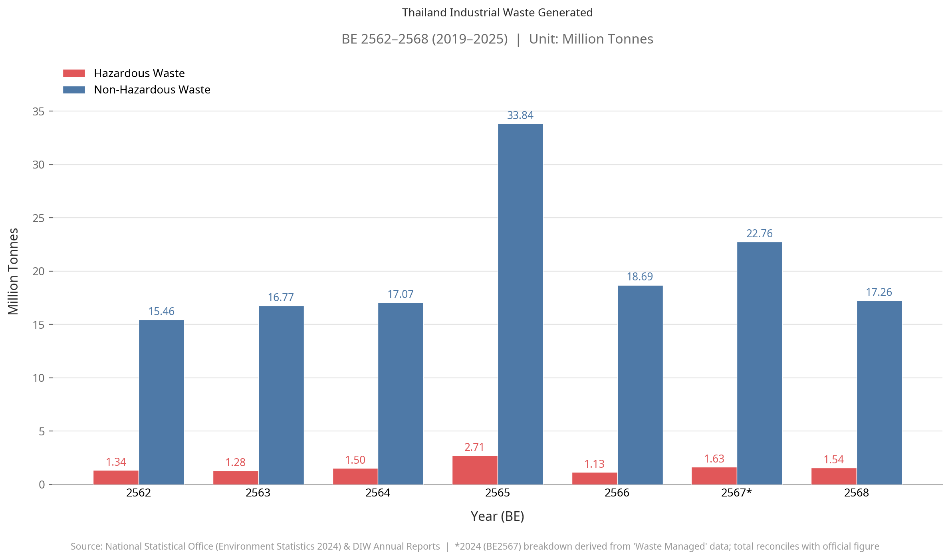
A clear turning point can be observed in 2022 (B.E. 2565), when the amount of waste recorded in the system increased significantly. The volume of non-hazardous waste reached 33.84 million tons, while hazardous waste amounted to approximately 2.71 million tons, bringing the total to approximately 36.55 million tons. This represented an increase of 96.82% compared with 2021(B.E. 2564).
One important factor was the implementation of the E-fully Manifest system, which was introduced to track waste or unused materials from their point of origin through to their final destination. The system helped improve the comprehensiveness of industrial waste reporting, management, and monitoring.
Therefore, when looking at Thailand’s industrial waste figures over the past seven years, we may see only a graph showing numbers rising and falling. However, behind these figures lies another important story: the transformation of Thailand’s industrial waste management and monitoring systems.
In my view, the significant increase in the figures in 2022 may have been related to improvements in the system, as well as efforts to clear or consolidate data and documentation that had remained outstanding from previous years. As a result, accumulated waste records or previously pending entries may have been entered into the system in large numbers during that year.
Meanwhile, in 2023 (B.E. 2566), the digital reporting system iSingle Form was introduced, accompanied by stricter monitoring and enforcement. Factories were required to manage and report their industrial waste data within the specified timeframe. This may have been one of the factors associated with the decline in the recorded figures compared with 2022(B.E. 2565).
Data from : https://www.diw.go.th/webdiw/pr64-233/?utm_source=chatgpt.com
: DIW Annual Report 2025 | PDF to Flipbook
: https://www.diw.go.th/webdiw/pr64-233/?utm_source=chatgpt.com
: https://www.diw.go.th/webdiw/pr66-307/?utm_source=chatgpt.com
(Bee)
2026-09-23 11:10:00
Failure to submit PRTR data to the authorities constitutes a violation that can lead to the revocation or refusal of renewal for health hazard business licenses defined by the Public Health Act. Please be reminded that the vast majority of manufacturing facilities qualify as health hazard businesses.
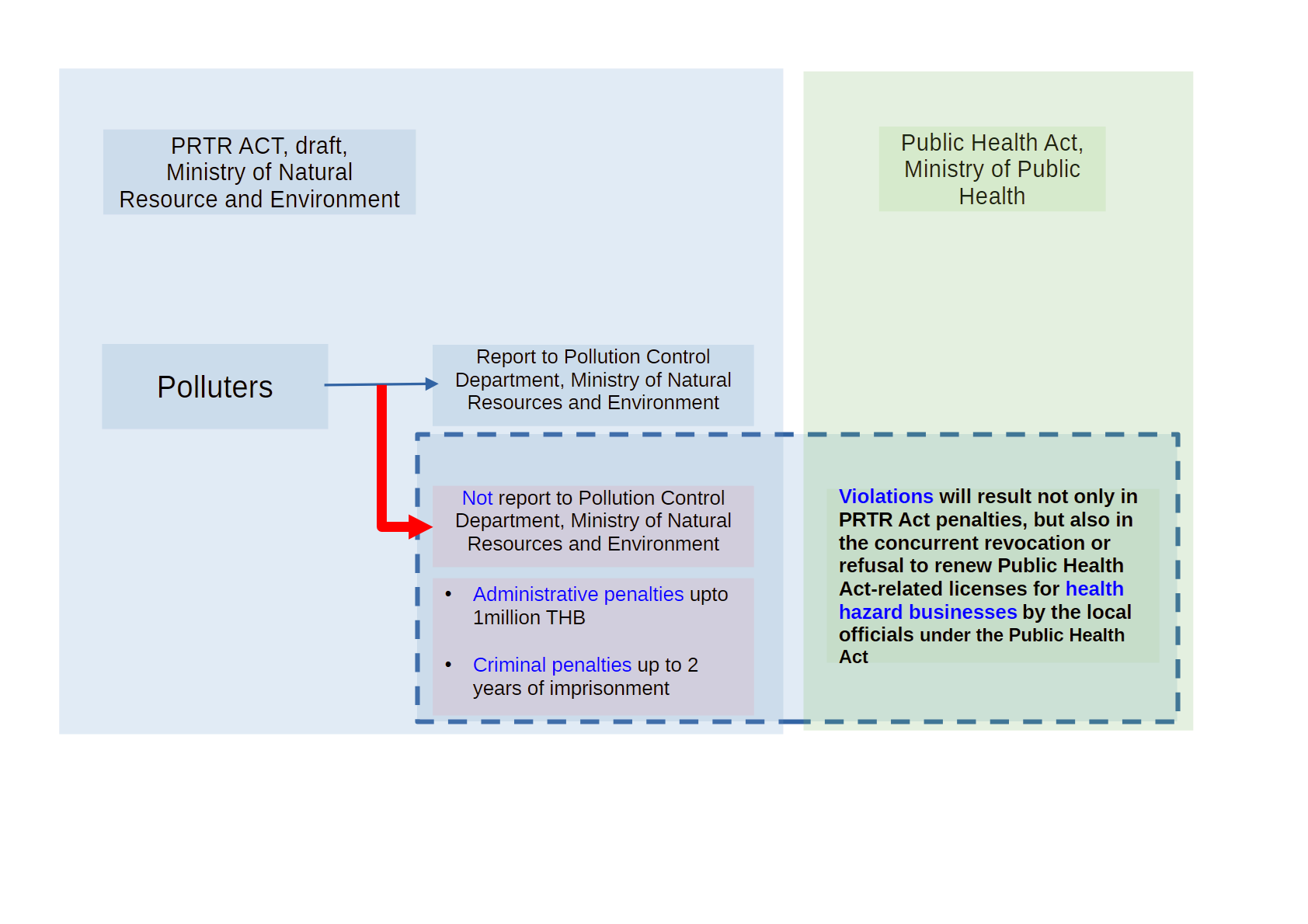
- Health Hazard Business List
2026-09-19 12:28:00
A public consultation for the enactment of the new “PRTR (Pollutant Release and Transfer Register) Act,” which is a prerequisite for OECD membership, is open from August 10 to September 30, 2026, at the following website: https://ethics.parliament.go.th/section77/survey_detail.php?id=614 .
1. Key Points of the Draft PRTR Act (Basic Law)
Covered Facilities
- Facilities (e.g., factories) that manufacture, possess, release into the environment, or transfer designated “target pollutants and chemicals” in quantities exceeding specified thresholds . Note that the specific pollutants and chemicals are not yet defined in this draft.
Reporting Obligations
- Each covered facility must report the manufactured and possessed quantities of target substances, their release into the environment (air, water, soil, etc.), and their transfer as waste or wastewater. These reports must be submitted to the Pollution Control Department (PCD) under the Ministry of Natural Resources and Environment at least once a year.
Public Disclosure
- The collected data—including release and transfer volumes, facility locations, and business types—will be compiled into a database. Citizens will have easy and free access to this database.
Protection of Trade Secrets
- If disclosing specific chemical names or possessed quantities would cause commercial disadvantage, businesses can file a request for non-disclosure citing “trade secrets”. If approved, a generic “chemical group name” can be used in place of the specific substance name for public disclosure.
Penalties
Failure to fulfill reporting obligations or comply with corrective orders will result in an administrative fine of 200,000 to 1,000,000 THB, with an additional maximum daily fine of 50,000 THB while the violation continues.
- Administrative Penalties: Failure to report or comply with regulatory orders carries a fine of 200,000 to 1,000,000 THB, plus an additional fine of up to 50,000 THB per day until compliance is achieved.
- Criminal Penalties: Submitting false information or concealing facts is punishable by imprisonment for up to 2 years, a fine of 500,000 to 5,000,000 THB, or both. In cases of corporate violations, directors or managers who issued the instructions are also subject to punishment.
2. Impact on Chemical Handling Businesses (Factories)
Increased Compliance and Operational Costs
- Businesses will need to establish systems for accurately measuring, calculating, and reporting release and transfer volumes, conduct testing and registration, and assign dedicated staff. This is expected to significantly increase administrative burdens and operational costs.
Reputation Risks from Public Disclosure
- Because emission data will be publicly available, environmental scrutiny from local residents and NGOs will intensify.
- High emission levels carry the risk of damaging the corporate image and provoking community backlash, necessitating strict accountability regarding environmental initiatives.
Strict Obligations for Intellectual Property Protection
- Companies must carefully navigate the balance between public disclosure and maintaining corporate secrets.
- To prevent the leakage of highly confidential chemical information (such as product formulations), companies must proactively file for “trade secret” protection and establish robust internal governance structures to substantiate these claims.
Severe Legal Risks for Management (Urgent Need to Strengthen Governance)
- Strict provisions are in place, meaning violations such as false reporting can lead not only to corporate fines but also to personal criminal penalties (e.g., imprisonment) for the executive management.
- Consequently, managing these obligations cannot be left solely to frontline staff; there is an urgent need to build a rigorous, top-management-driven chemical management and auditing framework (compliance system).
3. Pending Clarifications (Unconfirmed Matters)
Target Pollutants
- The current draft does not explicitly list the specific pollutants and chemicals to be targeted.
- It only defines the “criteria (properties)” for targeted substances, which include carcinogens, mutagens, reproductive toxicants, chronic toxicants, substances harmful to ecosystems, ozone-depleting substances, and persistent organic pollutants (POPs).
- The specific substance lists are expected to be clarified in future notifications from the Ministry of Natural Resources and Environment.
Definition of Target Facilities
- The exact definition of covered facilities is not clarified in the current draft.
- This is also expected to be detailed in future Ministry notifications.
4. Implementation Timeline
- In principle, the act will take effect on the day following its publication in the Royal Gazette.
- Provisions regarding non-point sources (mobile sources) will take effect two years after publication.
5. Transitional Measures
- The draft stipulates that within five years of the law’s enforcement, the application of designated areas will be expanded to cover all regions nationwide.
Potential Target Pollutants and Chemicals (Historical Reference)
The target substances from the PRTR pilot project—conducted jointly by the Japan International Cooperation Agency (JICA), the Ministry of Industry, and the Ministry of Natural Resources and Environment, and in which we were also involved—are shown in Table 1.
Please contact us if you need the rationale behind selecting these chemical substances through the Inquiry site.
| No. | Name of Chemical substance | Molecula Formula | CAS No. |
|---|---|---|---|
| 1 | Acetaldehyde | CH3CHO | 75-07-0 |
| 2 | Acetone | C3H6O | 67-64-1 |
| 3 | Acrylamide | C3H5NO | 6-1-1979 |
| 4 | Acrylic Acid | C3H4O2 | 1-6-1798 |
| 5 | Acrylonitrile | C3H3N | 107-13-1 |
| 6 | Ametryn | C9H17N5S | 834-12-8 |
| 7 | Antimony and its compunds | NA | 1309-64-4 |
| 7 | Antimony trisulfide | NA | 1345-04-6 |
| 8 | Arsenic and its compounds | NA | 7440-38-2 |
| 8 | Arsenobetaine and other organic arsenic compounds | NA | 64436-13-1 |
| 8 | Dimethylarsenic acid | NA | 75-60-5 |
| 9 | Atrazine | C8H14ClN5 | 1912-24-9 |
| 10 | Benzene | C6H6 | 71-43-2 |
| 11 | Benzyl Chloride | C7H7Cl | 100-44-7 |
| 12 | Bis(2-ethylhexyl)phthalate | C24H38O4 | 117-81-7 |
| 13 | Bisphenol A | C15H16O2 | 5-7-1980 |
| 14 | Boron and its compounds | NA | NA |
| 15 | 1-Bromo-2-chloroethane, | CH2BrCl | 107-04-0 |
| 16 | BUTACHLOR | C17H26ClNO2 | 23184-66-9 |
| 17 | Butadiene,1,3- | C4H6 | 106-99-0 |
| 18 | Cadmium and its compounds | NA | 7440-43-9 |
| 19 | Captan | C9H8Cl3NO2S | 133-06-2 |
| 20 | Carbon Disulfide | CS2 | 75-15-0 |
| 21 | Chloroacetaldehyde, 2- | C2H3ClO | 107-20-0 |
| 22 | Chloroacetic Acid | C2H3ClO2 | 11-8-1979 |
| 23 | Chloroform (trichloromethane) | CHCl3 | 67-66-3 |
| 24 | Chlorothalonil | C8Cl4N2 | 1897-45-6 |
| 25 | Chlorpyrifos | C9H11Cl3NO3PS | 2921-88-2 |
| 26 | Chromium and its componds | Cr | NA |
| 26 | Chromium (III) compounds | NA | 16065-83-1 |
| 26 | Chromium (VI) compounds | NA | 18540-29-9 |
| 26 | Chromium, metallic | NA | 7440-47-3 |
| 27 | Copper and soluble salts | Cu | NA |
| 27 | Copper 8-hydroxyquinoline | NA | 10380-28-6 |
| 28 | Cyclohexanone | C6H10O | 108-94-1 |
| 29 | D-BUTOTYL,2,4- | C14H18Cl2O4 | 1929-73-3 |
| 30 | D-BUTYL,2,4- | C12H14Cl2O3 | 94-80-4 |
| 31 | D-DIMETHYLAMMONIUM ,2, 4- | C10H13Cl2NO3 | 2008-39-1 |
| 32 | DIALIFOS(DIALIFOR) | C14H17ClNO4PS2 | 10311-84-9 |
| 33 | Dichlorobenzene, 1,4- | C6H4Cl2 | 106-46-7 |
| 34 | Dichloroethane, 1,2- | C2H4Cl2 | 107-06-2 |
| 35 | Dichlorophenoxy Acetic Acid, 2,4- | C8H6Cl2O3 | 94-75-7 |
| 36 | Dichlorvos | C4H7Cl2O4P | 62-73-7 |
| 37 | Diethylene Glycol Monobutyl Ether | C8H18O3 | 112-34-5 |
| 38 | DITHIOPYR | C15H16F5NO2S2 | 97886-45-8 |
| 39 | Epichlorohydrin | C3H5ClO | 106-89-8 |
| 40 | Ethyl Acetate | C4H8O2 | 141-78-6 |
| 41 | Ethyl Acrylate | C5H8O2 | 140-88-5 |
| 42 | Ethylene Glycol | C2H6O2 | 107-21-1 |
| 43 | Ethylene Glycol Monobutyl Ether | C6H14O2 | 111-76-2 |
| 44 | Ethylene Oxide | C2H4O | 75-21-8 |
| 45 | Formaldehyde | CH2O | 50-00-0 |
| 46 | Formic Acid | CH2O2 | 64-18-6 |
| 47 | Furfural | C5H4O2 | 1-1-1998 |
| 48 | GLYPHOSATE-ISOPROPYLAMMONIUM | C6H17N2O5P | 38641-94-0 |
| 49 | Hexachlorocyclohexane | C6H6Cl6 | 319-86-8 |
| 50 | Hexane, N- | C6H14 | 110-54-3 |
| 51 | Hexanedioic Acid | C6H10O4 | 124-04-9 |
| 52 | Hydrogen Fluoride | HF | 7664-39-3 |
| 53 | Hydroquinone | C6H6O2 | 123-31-9 |
| 54 | IMAZAQUIN-AMMONIUM | C17H20N4O3 | 81335-47-9 |
| 55 | Isobutyl Alcohol | C4H10O | 78-83-1 |
| 56 | Isophorone | - | 78-59-1 |
| 57 | Isopropyl alcohol | C3H8O | 67-63-0 |
| 58 | Lead and Compounds | Pb | 7439-92-1 |
| 59 | Maleic Anhydride | C4H2O3 | 108-31-6 |
| 60 | Managenses and its compounds | NA | NA |
| 61 | Methanol | CH4O | 67-56-1 |
| 62 | (p-METHOXYPHENYL)-2-METHYL-1,3- PROPANEDIOL-METHYLENE ETHER ,1- | - | 5689-72-5 |
| 63 | Methyl Acetate | C3H6O2 | 79-20-9 |
| 64 | Methyl Acrylate | C4H6O2 | 96-33-3 |
| 65 | Methyl Ethyl Ketone (2-Butanone) | C4H8O | 78-93-3 |
| 66 | Methyl Isobutyl Ketone (4-methyl-2-pentanone) | C6H12O | 108-10-1 |
| 67 | Methyl Methacrylate | C5H8O2 | 80-62-6 |
| 68 | Methyl tert-Butyl Ether (MTBE) | C5H12O | 1634-04-4 |
| 69 | Methylene Chloride | CH2Cl2 | 9-2-1975 |
| 70 | Methylenediphenyl Diisocyanate | C15H10N2O2 | 101-68-8 |
| 71 | Molybdenum and its compounds | NA | NA |
| 72 | Naphthalene | C10H8 | 91-20-3 |
| 73 | Nickel and its compounds | NA | NA |
| 74 | Paraquat Dichloride | C12H14Cl2N2 | 1910-42-5 |
| 75 | Pentane, n- | C5H12 | 109-66-0 |
| 76 | Phenol | C6H6O | 108-95-2 |
| 77 | Phosphoric Acid | H3PO4 | 7664-38-2 |
| 78 | Phosphorus pentoxide and other | P2O5 | 1314-56-3 |
| 79 | Phthalic Anhydride | C8H4O3 | 85-44-9 |
| 80 | Polyethylene glycol nonylphenyl ether | C19H32O3 | 9016-45-9 |
| 81 | Potassium chlorate | ClKO3 | 4-9-3811 |
| 82 | Propanil | C9H9Cl2NO | 709-98-8 |
| 83 | PROPIONICACID | C3H6O2 | 9-4-1979 |
| 84 | Propylene | C3H6 | 115-07-1 |
| 85 | Propylene Glycol | C3H8O2 | 57-55-6 |
| 86 | Propylene Oxide | C3H6O | 75-56-9 |
| 87 | PROTHIOCARB | C8H19ClN2OS | 19622-08-3 |
| 88 | Pyrene | C16H10 | 129-00-0 |
| 89 | Ryania | C25H35NO9 | 15662-33-6 |
| 90 | sodium chlorate | ClNaO3 | 7775-9-9 |
| 91 | Sodium Cyanide | NaCN | 143-33-9 |
| 92 | Styrene | C8H8 | 100-42-5 |
| 93 | Tebuthiuron | C9H16N4OS | 34014-18-1 |
| 94 | Tetrachloroethylene | C2Cl4 | 127-18-4 |
| 95 | Tin and its compounds | NA | NA |
| 96 | Toluene | CH3C6H5 | 108-88-3 |
| 97 | Trichloroethylene | C2HCl3 | 1-6-1979 |
| 98 | Trimethylbenzene, 1,2,4- | C9H12 | 95-63-6 |
| 99 | Trimethylbenzene, 1,3,5- | C9H12 | 108-67-8 |
| 100 | Trinitrotoluene, 2,4,6- | C7H5N3O6 | 118-96-7 |
| 101 | Vinyl Acetate | C4H6O2 | 108-05-4 |
| 102 | Vinyl Chloride | C2H3Cl | 1975-01-4 |
| 103 | Xylenes | CH3C6H5 | 1330-20-7 |
| 104 | Zinc and its compounds | NA | NA |
| 105 | Sox | NA | NA |
| 106 | NOx | NA | NA |
| 107 | Dioxin and Furan | NA | NA |
| 107 | 2,3,7,8-Tetrachlorodibenzo-para-dioxin | NA | 1746-01-6 |
| 107 | Dibenzo-para-dioxin | NA | 262-12-4 |
| 107 | Polychlorinated biphenyls (PCBs), | NA | NA |
| 107 | 3,4,5,3’,4’-Pentachlorobiphenyl (PCB-126) | NA | 57465-28-8 |
| 107 | Furan | NA | 110-00-9 |