blog post

2026-02-25 18:38:00

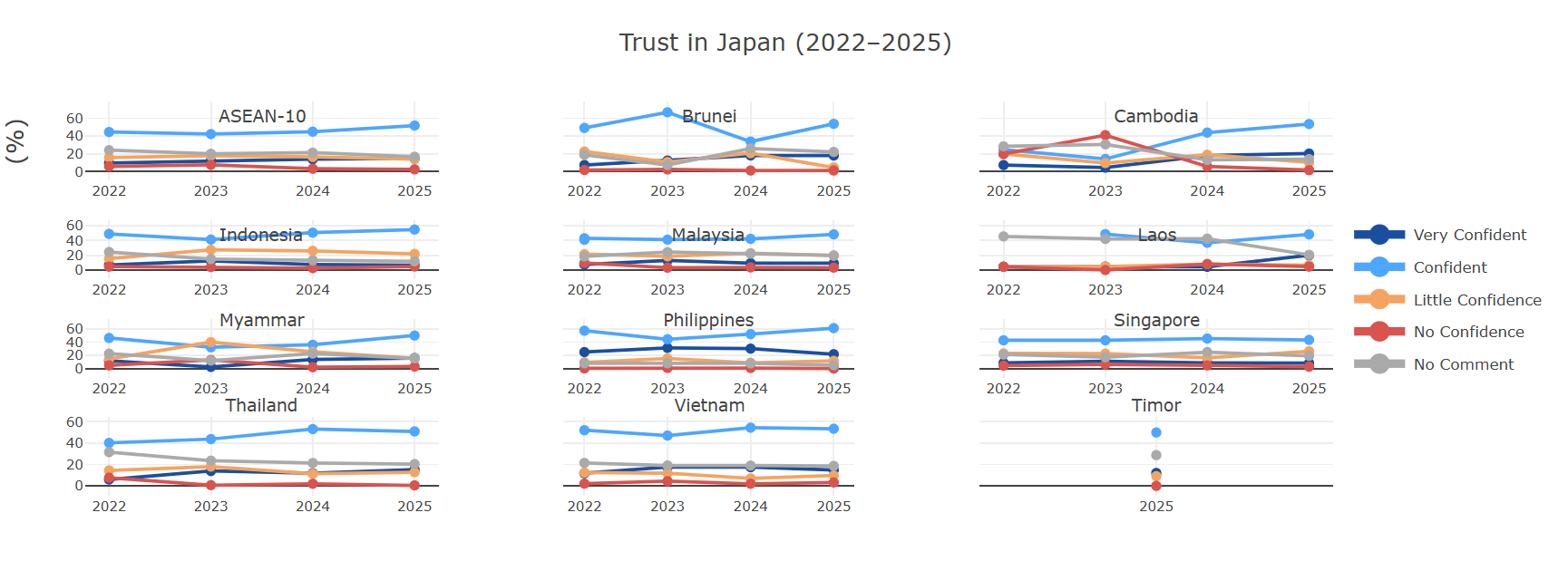
日本への信頼感推移(2022-2025)

Biz

Rplot01.png

出所:YUSOF ISHAK INSTITUTEのデータから作成。


タイ

2022年は信頼率46.2%・不信率22.2%と、信頼感がASEAN-10平均(54.2%)を大きく下回る。しかし2023年57.7%、2024年65.1%と急速に改善し、2025年には66.3%・不信率13.3%でASEAN-10平均にほぼ並び。


ベトナム

2022年時点ですでに信頼率63.9%と高く、ASEAN-10平均を約10%ポイント上回っていた。2024年には72.0%・不信率9.0%とピークを記録したが、2025年は信頼率68.3%・不信率12.9%とやや反落。


インドネシア

2022年は55.8%とほぼASEAN-10平均並み。2023年に不信率が31.4%へ急騰し、信頼率も53.7%へ低下しました。2024・2025年は信頼率が60%台へ持ち直したものの、不信率は26〜29%台で高止まりでASEAN-10平均(16.5%)との差が4年間で拡大中。


出所

The State of Southeast Asia Survey Report, ISEAS-Yusof Ishak Institute

https://www.iseas.edu.sg/frontpage-featured/the-state-of-southeast-asia-2025-survey-report/

調査概要:
調査対象:ASEAN全10カ国の政府、学術界、ビジネス界、メディア、市民社会の5つのカテゴリーから選ばれた千数百人(毎年)

(Hashimoto, Bee)


2026-02-24 18:29:00

Thailand’s 2026 Summer Has Arrived — Slightly Hotter Than Last Year

summer_season_thai.png

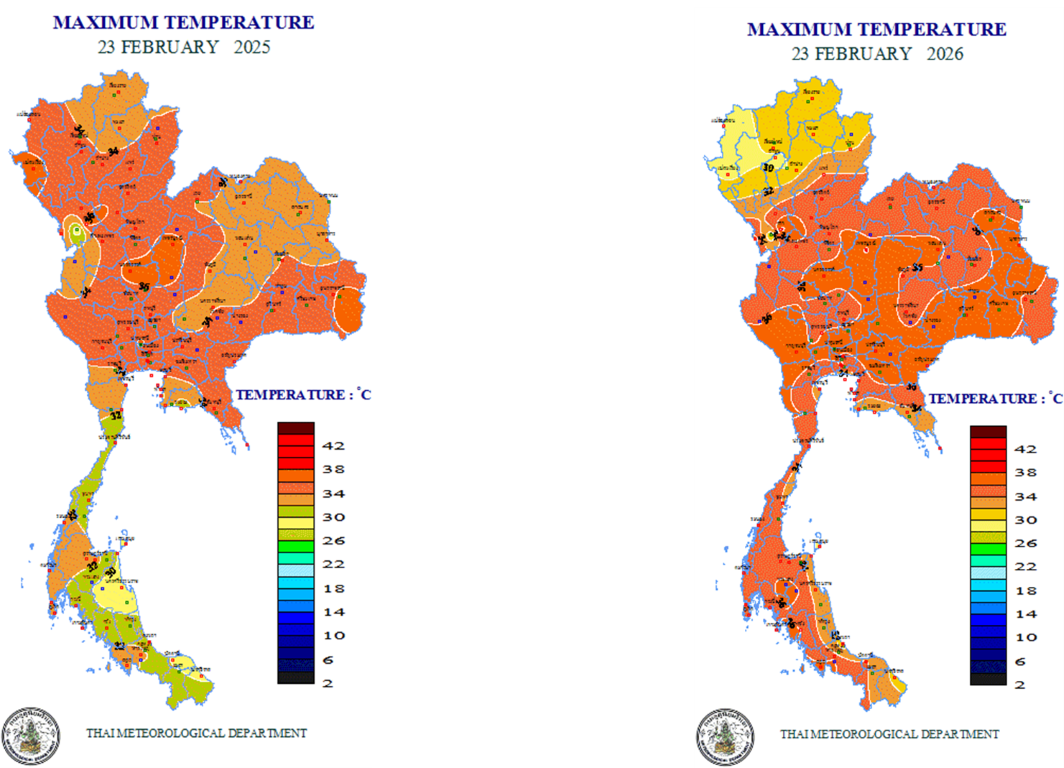
Thailand’s summer season officially began on February 22, 2026, according to the Thai Meteorological Department. This year, temperatures are expected to be slightly higher than last year’s average.


In the northern and upper regions of Thailand, average maximum temperatures are forecast to reach around 36–37°C. In some high-risk areas, temperatures may climb to 42–43°C during peak periods. Provinces to watch closely include Mae Hong Son, Lampang, and Tak.


The hottest period is expected from late March to mid-April, which coincides with increased travel, tourism activity, and higher electricity consumption.


Rising temperatures each year are not just about discomfort — they also affect public health, outdoor work productivity, and household energy costs. Preparing in advance, staying hydrated, and managing energy use wisely will be essential during this year’s hot season.

Data from the Thai Meteorological Department : https://shorturl.asia/n9Y8o

(Bee)

2026-02-24 18:26:00

ฤดูร้อนประเทศไทยปี 2026 มาถึงแล้ว — ร้อนกว่าปีก่อนเล็กน้อย

summer_season_thai.png


ปีนี้ฤดูร้อนของ ประเทศไทย เริ่มต้นอย่างเป็นทางการตั้งแต่วันที่ 22 กุมภาพันธ์ 2569 ตามประกาศของ กรมอุตุนิยมวิทยา พร้อมการประเมินว่าอุณหภูมิโดยรวมจะสูงกว่าปีก่อนเล็กน้อย


พื้นที่ภาคเหนือและตอนบนมีแนวโน้มอุณหภูมิสูงสุดเฉลี่ยอยู่ที่ประมาณ 36–37 องศาเซลเซียส และบางจังหวัดอาจแตะ 42–43 องศาเซลเซียสในช่วงพีก โดยจังหวัดที่ต้องจับตาเป็นพิเศษ ได้แก่ แม่ฮ่องสอน, ลำปาง และ ตาก

ช่วงเวลาที่ร้อนจัดที่สุดคาดว่าจะอยู่ระหว่างปลายเดือนมีนาคมถึงกลางเดือนเมษายน ซึ่งมักเป็นจังหวะที่การเดินทาง การท่องเที่ยว และการใช้ไฟฟ้าเพิ่มสูงขึ้นตามไปด้วย


อากาศที่ร้อนขึ้นทุกปีไม่ใช่แค่เรื่องความรู้สึก แต่กระทบทั้งสุขภาพ การทำงานกลางแจ้ง และค่าใช้จ่ายในครัวเรือน การเตรียมตัวล่วงหน้า ทั้งการดูแลร่างกายและบริหารการใช้พลังงาน จึงเป็นเรื่องสำคัญสำหรับหน้าร้อนปีนี้


ข้อมูลจากกรมอุตุนิยมวิทยา : https://shorturl.asia/n9Y8o

(Bee)

2026-02-12 11:07:00

Top 20 items exported to Cambodia from Thailand between 2021 and 2025

Biz

Items exported to Cambodia from Thailand

Items exported to Cambodia from Thailand

Unit: kilo USD

Top 20 exported items to Cambodia from Thailand between 2021 - 2025
Rating Items 2021 2022 2023 2024 2025
1 Vehicles other than railway or tramway rolling stock, and parts and accessories thereof 651,869 720,620 362,910 528,327 645,934
2 Mineral fuels, mineral oils and products of their distillation; bituminous substances; mineral … 845,157 1,067,311 738,108 938,636 471,116
3 Nuclear reactors, boilers, machinery and mechanical appliances; parts thereof 258,351 218,251 161,000 223,284 321,042
4 Electrical machinery and equipment and parts thereof; sound recorders and reproducers, television … 209,686 210,494 220,594 202,985 168,587
5 Beverages, spirits and vinegar 193,465 178,306 164,614 180,365 109,662
6 Sugars and sugar confectionery 39,772 59,508 74,478 100,354 108,257
7 Rubber and articles thereof 27,804 28,353 32,368 79,713 84,339
8 Plastics and articles thereof 101,462 97,590 74,205 78,404 77,346
9 Essential oils and resinoids; perfumery, cosmetic or toilet preparations 55,192 62,134 69,021 74,707 66,849
10 Fertilisers 90,037 76,070 73,601 97,060 55,959
11 Miscellaneous edible preparations 41,639 48,990 49,075 51,901 50,430
12 Aluminium and articles thereof 58,963 66,541 72,140 76,274 48,838
13 Preparations of cereals, flour, starch or milk; pastrycooks’ products 18,561 24,367 34,824 62,332 45,255
14 Soap, organic surface-active agents, washing preparations, lubricating preparations, artificial … 35,742 40,137 45,153 45,647 41,127
15 Knitted or crocheted fabrics 71,868 86,537 49,003 47,996 41,019
16 Paper and paperboard; articles of paper pulp, of paper or of paperboard 43,254 39,313 31,602 39,669 40,252
17 Residues and waste from the food industries; prepared animal fodder 48,424 77,525 88,958 52,301 40,239
18 Articles of iron or steel 21,590 32,391 46,115 76,616 38,823
19 Inorganic chemicals; organic or inorganic compounds of precious metals, of rare-earth metals, … 13,644 15,258 17,758 23,965 32,786
20 Miscellaneous chemical products 24,920 26,648 18,188 23,439 30,573
2026-02-06 17:06:00

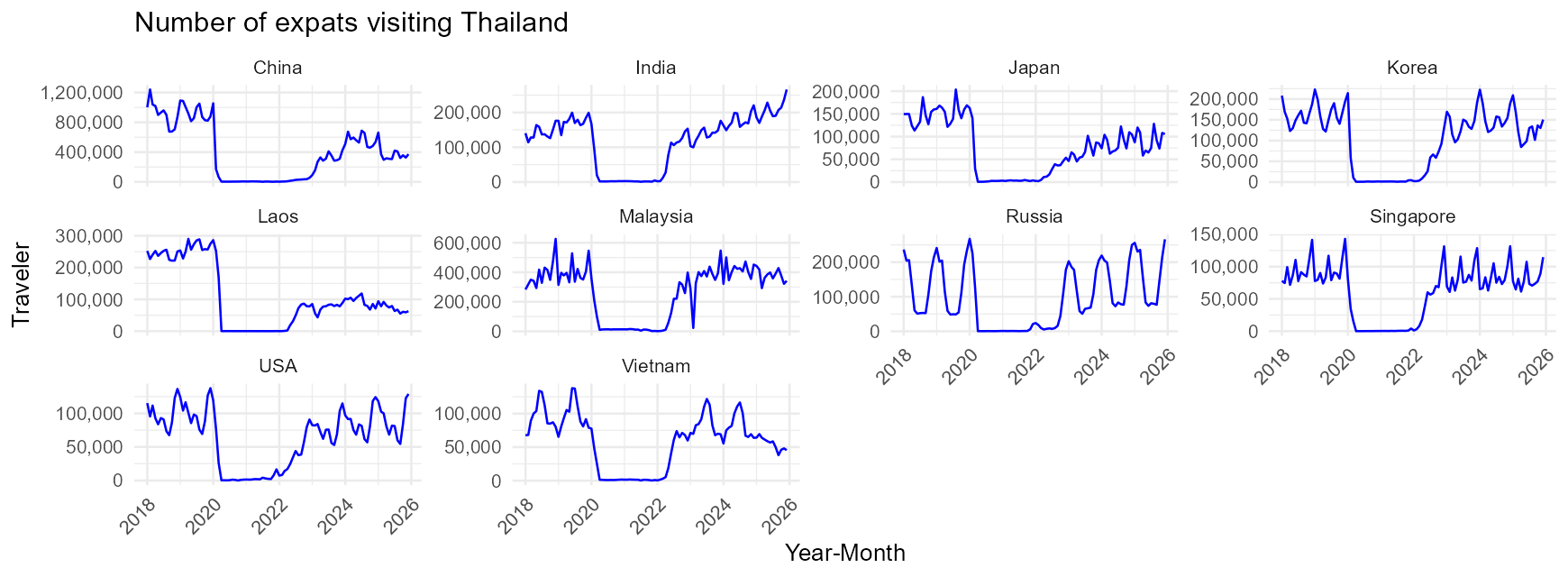
Number of expats visiting Thailand each month from 2018 to the end of 2025.

Rplot2025.png

 Source: Prepared by HS-TECH based on the data from https://www.mots.go.th/news/category/806

Japan

Gradual & Cautious Recovery Unlike the explosive return seen in some markets, Japan’s recovery has been slow and steady. Post-pandemic numbers (from late 2022 into 2023) show a consistent upward trend, but the total volume remains significantly lower than the 2019 peaks. Japanese travelers have returned at a rate of roughly 50-60% of pre-COVID levels, likely dampened by the weak Yen which has made overseas travel more expensive.


China

Delayed but Explosive Spike China’s trend is characterized by a "late start." Comparison shows near-zero travel throughout 2022 due to extended lockdowns. However, the data reveals a sharp, vertical spike in early 2023 immediately following the reopening of borders. Despite this rapid growth rate, the absolute volume has not yet fully reclaimed the dominant #1 position it held in 2018-2019, showing a steep recovery curve that is still in progress.


India

Rapid & Robust Resurgence India distinguishes itself with a powerful "V-shaped" recovery. While East Asian neighbors lagged, Indian arrivals surged almost immediately after restrictions eased in 2022. By early 2023, monthly volumes were already closing in on pre-pandemic (2019) levels, driven by strong organic demand and improved flight connectivity. India has thus emerged as a "standout" market, recovering far faster than Japan or China.


To revitalize tourism from China, the Thai government has implemented the following key strategies:

  1. Permanent Visa Waiver: Starting March 1, 2024, Thailand and China entered a mutual permanent visa-exemption agreement. This allows Chinese citizens to stay for up to 60 days without a visa, significantly reducing the cost and effort of travel compared to pre-pandemic requirements.

  2. "Nihao Month" and Targeted Promotions: The Tourism Authority of Thailand (TAT) launched campaigns like "Nihao Month" (Sept–Dec 2024) to coincide with China’s National Day and Golden Week. They partnered with major Chinese platforms like Trip.com and Huawei to offer special discounts and tailored travel packages.

  3. Enhanced Safety Measures: To counter safety concerns fueled by Chinese social media and viral films (e.g., No More Bets), the government introduced "Smart Safety" initiatives. This includes deploying AI-driven security at major airports and establishing a 24-hour emergency call center specifically for foreign tourists.

  4. Geopolitical Reassurance: In high-level meetings, the Thai government reassured Beijing of its commitment to tackling transnational crime. Crucially, officials pledged to oppose the legalization of casino resorts to win favor and address concerns about illegal gambling-related activities.

  5. Flight Connectivity: The government has incentivized airlines to increase flight frequencies between major Chinese cities and Thai destinations like Bangkok, Phuket, and Chiang Mai to lower airfares.